The 49ers' Injury Problem: What If We're Asking the Wrong Questions?
Nearly a decade of injury concerns raises a bigger question about how professional sports organizations investigate persistent problems.
At what point does an organization stop looking at individual injuries and start asking whether there is a bigger problem?
I've been following the San Francisco 49ers' injury history, and it's difficult to ignore how frequently this organization finds itself having the same conversation.
Another significant injury. Another player unavailable. Another season affected by the health of the roster.
Injuries are part of professional football. Nobody is going to eliminate them, and I wouldn't suggest that every injury can be prevented. But when a team repeatedly experiences a substantial injury burden over several years, I think it's reasonable to ask whether there's more to investigate.
I'm not suggesting I know what's happening inside the 49ers organization. I don't.
What interests me is how we approach a problem like this in the first place.
Is There Actually a Pattern?
Before looking for explanations, we need to establish whether the problem is real.
According to Aaron Schatz's Adjusted Games Lost (AGL) data, the 49ers have ranked among the NFL's more injury-affected teams throughout much of Kyle Shanahan's tenure.
AGL is useful because it considers injury-related player availability rather than simply counting the number of injuries.
Here is how San Francisco has ranked since 2017.
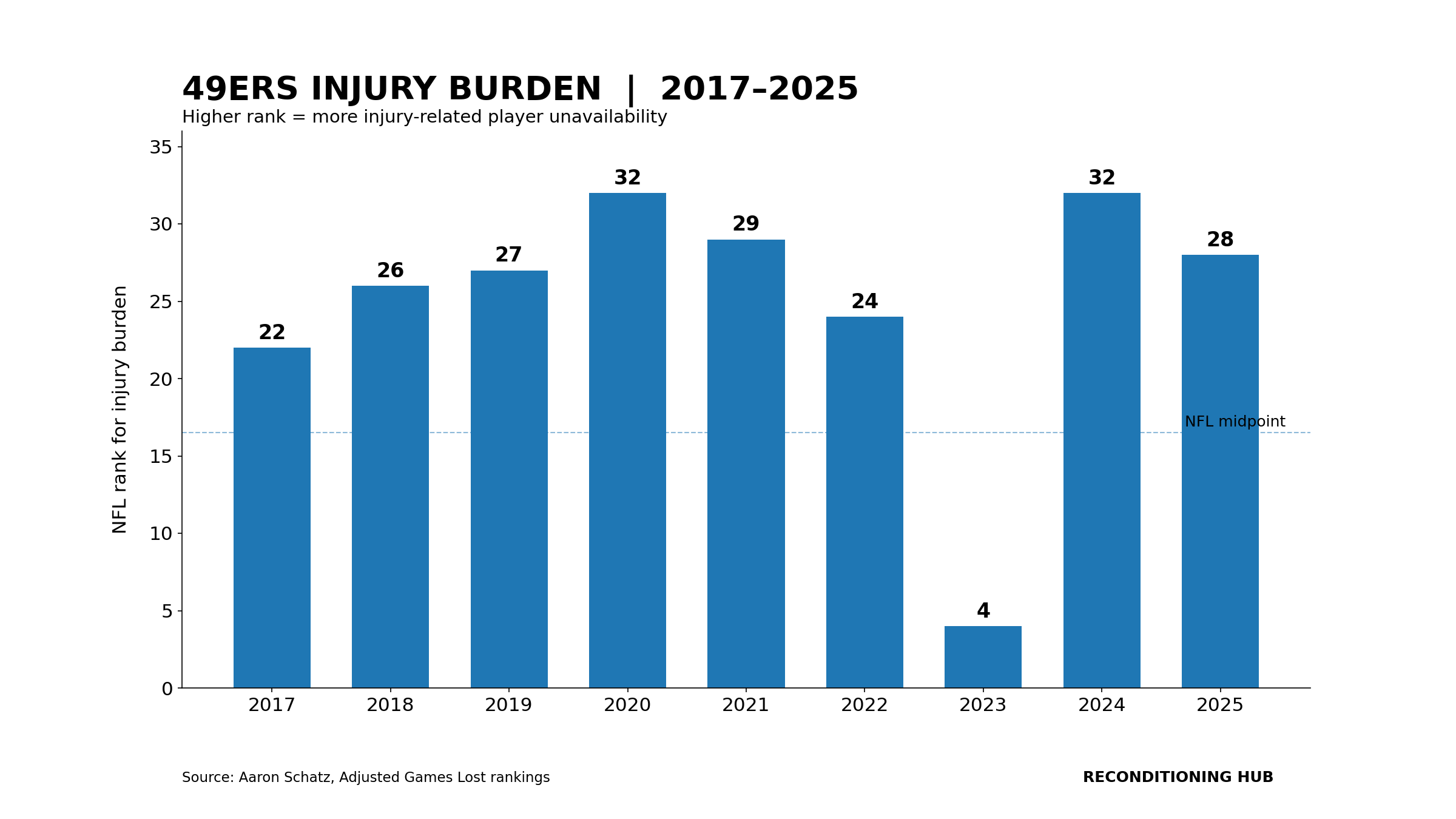
Rankings run from 1st, the lowest injury burden, to 32nd, the highest.
The 49ers were in the more injury-affected half of the NFL in eight of those nine seasons.
In 2024, they recorded 141.2 adjusted games lost, the highest total in the league. That followed a 2023 season in which they recorded just 34.5, one of the lowest totals.
In 2025, their injury burden remained substantial at 115 AGL.
The interesting part is that the team's performance hasn't always followed the same pattern.
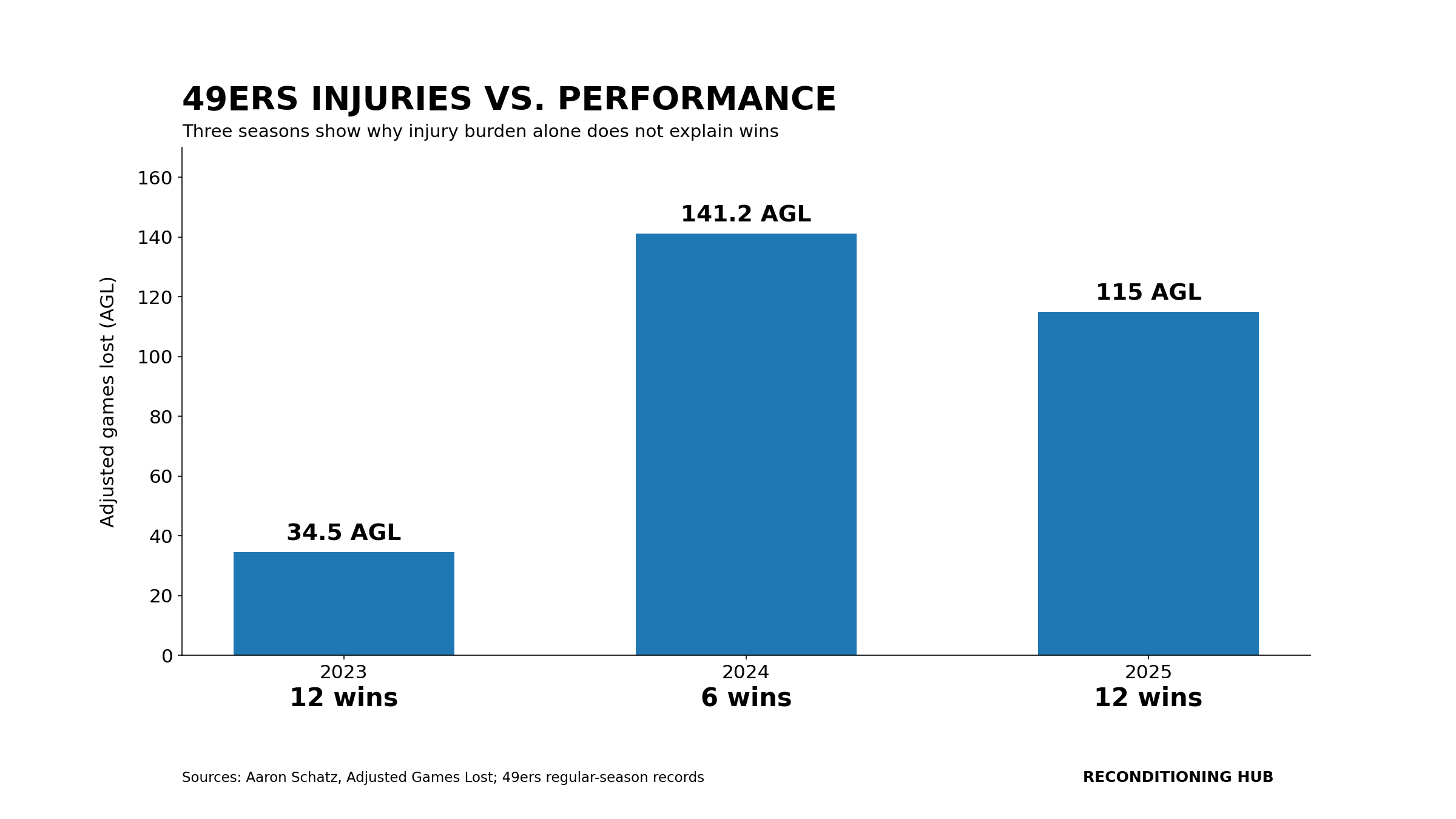
San Francisco reached the Super Bowl following its comparatively healthy 2023 season. The following year, injuries increased dramatically and the team missed the playoffs.
But in 2025, despite another substantial injury burden, the 49ers returned to 12 wins.
That tells me we need to be careful about drawing simple conclusions.
Which athletes are injured, when those injuries occur, how long they remain unavailable and how the organization responds may matter just as much as the total number of injuries.
Still, the broader pattern deserves attention.
How Many Possible Explanations Are There?
After more than 20 years working in and around professional sport, I've learned that there are often more factors contributing to an injury than we initially recognize.
Start with the athlete.
What is their previous injury history? Have they undergone surgery? Are there unresolved movement limitations? How much physical capacity have they restored following previous injuries?
What about their training exposure, recovery, nutrition, sleep and ability to tolerate the demands of their position?
Then consider the organization surrounding that athlete.
Coaching philosophy, practice intensity, strength and conditioning, medical care, rehabilitation, communication between departments, travel schedules, roster construction and return-to-performance decisions.
Even the way a team plays football deserves consideration.
Does its playing style expose athletes to particular physical demands? Are those demands reflected in how the athletes prepare?
And what happens when several players at the same position become injured? The remaining athletes may suddenly be asked to tolerate workloads they weren't originally preparing for.
These are all questions worth examining.
Not because any one of them necessarily explains the 49ers' situation, but because an injury history involving an entire organization is unlikely to be understood by looking at one variable in isolation.
What About the Electrical Substation?
One of the stranger questions surrounding the 49ers’ injury history involves the electrical infrastructure beside their training facility.
At first, I was inclined to dismiss this because the 49ers have trained in Santa Clara since 1988 and electrical infrastructure existed in the area long before their current injury problems.
But the timeline is more interesting than that.
The older Tasman Substation was relocated as part of the development surrounding Levi’s Stadium. The electrical infrastructure adjacent to the training complex was significantly changed around the time the stadium opened in 2014.
That timing caught my attention for another reason.
According to injury data cited by The Washington Post, the 49ers were below the NFL average for injuries from 2001 through 2014. Their more persistent injury problems developed in the years that followed.
Does that mean the substation is responsible?
Absolutely not.
Two things occurring around the same time doesn’t establish that one caused the other. There were numerous other changes during that period, and current scientific evidence has not established that electromagnetic fields at the reported exposure levels cause the types of musculoskeletal injuries experienced by the 49ers.
The 49ers took the question seriously enough to investigate it. In 2026, John Lynch said an independent scientist found nothing concerning, calling it a “big nothing burger.” The actual testing data wasn’t released publicly.
But imagine if it had found something significant. The implications would be enormous. Move the practice facility? The stadium?
For me, that doesn’t make the environmental question the answer. It simply makes it another variable worth examining.
What exactly changed around the facility? When did it change? What were the exposure levels before and after? Have they changed again since? How do those levels compare with other NFL facilities? And does any of it line up with the team’s injury data when we look at it objectively?
It may lead nowhere.
But if the purpose of an investigation is to understand why a problem keeps occurring, I wouldn’t exclude a potential variable simply because it sounds unusual.
I would measure it, compare it, and either find a reason to investigate further or move on.
What Would a Proper Investigation Look Like?
If I were approaching this from a reconditioning perspective, I wouldn't begin by deciding what I thought was causing the problem.
I'd begin by trying to understand it.
First, I'd want a comprehensive review of the injuries themselves.
Not just the number of players on injured reserve.
I'd want to know the injury type, mechanism, previous injury history, recurrence, time lost and whether athletes were experiencing subsequent injuries elsewhere.
I'd want to distinguish injuries sustained through unavoidable contact from those occurring without an obvious external mechanism.
Then I'd examine the organizational factors.
How have training practices changed over the years? What about the roster, medical staff, strength and conditioning department, recovery strategies and playing surfaces?
The 49ers have already made changes in some of these areas. Their head athletic trainer and strength coach were replaced in 2019, and the team changed its practice field surface in 2024.
Did those changes influence injury patterns? If not, why not?
I'd be particularly interested in the 2023 season.
What was different that year?
Was the team simply fortunate to avoid significant injuries, or were there meaningful differences in roster composition, preparation, recovery or player availability?
Sometimes the periods when a problem isn't occurring can teach us as much as the periods when it is.
I would also want people from different disciplines involved in the investigation.
Sports medicine, athletic therapy/training strength and conditioning, biomechanics, epidemiology and, where justified by the evidence, environmental health.
The goal wouldn't be to have everyone arrive with their favourite theory.
It would be to examine the available information and determine which explanations deserve further investigation.
Of course, there are limits to what can be established. Football is a contact sport, injuries are multifactorial, and some events will occur regardless of how well an athlete is prepared.
But I would rather understand those limitations than assume we have already asked every relevant question.
Would an Organization Actually Want to Undertake Something Like This?
This is probably the part that interests me most.
Professional sports organizations are under enormous pressure to produce results.
When a player gets injured, someone has to replace him. When a season doesn't meet expectations, coaches and performance staff may come under scrutiny.
Sometimes personnel changes are necessary. I understand that.
But replacing a person doesn't necessarily change the conditions they were working within.
I actually tried to undertake a project like this with the Montreal Canadiens around 2012–13. I was much younger then, and my thinking and approach have evolved considerably since. But the basic premise was similar: how do we look at our injuries from every possible angle, identify patterns and potential contributing factors, and address the problem systemically rather than simply treating each injury as an isolated event?
There was genuine interest from ownership, but after a change in hockey management, the project never moved forward. That experience has stayed with me. An investigation like this only works if the organization itself is willing to look broadly at the problem and follow the questions wherever they lead.
The 49ers have already changed members of their performance staff, adjusted their practice surfaces and turned over significant portions of their roster during this period.
Yet the injury conversation continues.
I don't know what the organization has investigated internally, and it would be unfair to assume they haven't examined these issues.
But imagine commissioning a truly independent investigation into a persistent organizational problem.
One with access to medical histories, training records, rehabilitation data, facility information and the people making decisions throughout the organization.
What if the findings challenged established practices?
What if they raised questions about roster construction, coaching philosophy, communication between departments or the physical environment?
What if the investigation identified several contributing factors rather than one clear explanation?
Would leadership be willing to make changes based on those findings?
And would they still consider the project worthwhile if it didn't produce an easy answer?
There is a practical challenge here, too. An investigation of this scope would require significant resources, cooperation and a willingness to examine decisions made at multiple levels of an organization.
It may be easier to make the next personnel change, sign the next replacement player and hope the following season is different.
But if the underlying problem remains, what has really changed?
I See the Same Thing With Individual Athletes
This is where the subject becomes particularly relevant to the work I do.
I've worked with athletes and clients who have experienced repeated injuries or persistent pain despite receiving treatment from multiple practitioners.
They may have had excellent medical care and followed their rehabilitation programs.
Yet something still isn't right.
Sometimes they need a different treatment approach. Sometimes they need more time, different treatment or a better progression of movement and physical loading.
Other times, we need to revisit our understanding of the problem altogether.
What have we overlooked?
Are previous injuries influencing their current movement or capacity?
Is there something about their training or daily environment that continues to expose them to demands they aren't prepared to tolerate?
Have we become so focused on treating the injured area that we've stopped examining the person?
I see a parallel between that individual athlete and an organization experiencing repeated injury problems.
We can keep treating the latest injury, replacing the unavailable athlete or changing the practitioner.
Sometimes those decisions are necessary and effective.
But when the same broad problem keeps returning, I think we owe it to ourselves to ask whether there's something we still don't understand.
The Question I Keep Coming Back To
I don't know why the 49ers have experienced such a substantial injury burden over the past decade.
There may be several contributing factors, some modifiable and others simply part of the physical demands of professional football.
There may never be one clear explanation.
But I wonder what could be learned if an organization committed to investigating every reasonable possibility without deciding in advance what the answer should be.
Not to blame the coach, medical staff or performance department.
Not to prove an environmental theory.
And not to justify decisions that have already been made.
To understand what is actually happening and determine whether anything meaningful can be changed.
Because replacing an injured player may solve the immediate roster problem.
It doesn't necessarily explain why the organization keeps finding itself in the same position.