Mathew Barzal Played 81 Games. So Why Isn't His Knee Ready?
His surgery was described as minor, with a reported six-week recovery estimate. His actual return took eight months. He then played 81 NHL games and produced 72 points while managing his knee. Now, more than 20 months after surgery, he's still not ready. What changed?
Mathew Barzal's situation raises a question that I believe deserves considerably more attention.
Last season, the New York Islanders forward played 81 games, scored 19 goals and recorded 72 points. By almost every conventional measure, he had successfully returned from the knee injury that ended his previous season.
But had he actually recovered?
Here we are in October 2026, and Barzal has yet to return to the Islanders' lineup.
The inflammation that interrupted his preparation for the season is reportedly under control. He's skating again. His doctors are comfortable with him progressing his workload. But he isn't ready.
How does an athlete go from playing almost an entire NHL season to being unable to begin the next one?
Did Barzal fully recover from his knee injury, or did he simply recover enough to play?
Having spent much of my career working with hockey players and helping people recover from complex injuries, I think this distinction is critically important.
A "minor procedure" that took eight months
On February 1, 2025, Barzal blocked a shot from Tampa Bay Lightning defenseman Darren Raddysh. The puck struck his left kneecap, resulting in a patellar injury that required surgery.
Pierre LeBrun reported that Barzal had undergone a minor procedure, with a typical recovery estimate of approximately six weeks.
That timeline caught my attention.
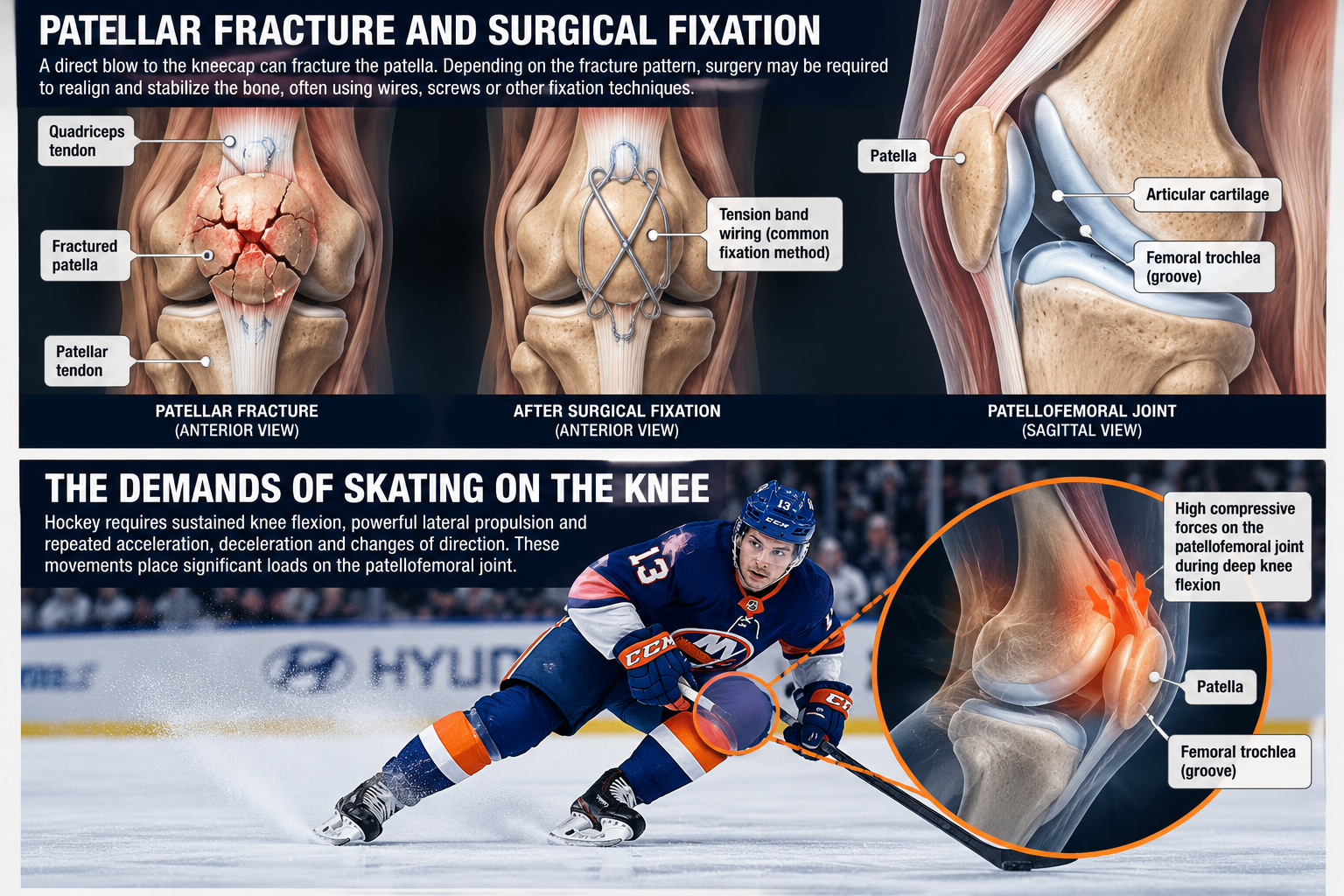
In my clinical experience, surgically treated patellar fractures can be particularly challenging injuries. Every case I've personally managed involved substantial rehabilitation, often following fixation with wires to stabilize multiple bone fragments.
In more severe injuries, a direct impact can fracture the patella into several pieces, potentially involving the articular surface that contacts the femur.
Restoring strength, mobility, neuromuscular control and tolerance to loading following these injuries is a process measured in months, not weeks.
And the research supports that experience.
Studies have demonstrated persistent quadriceps weakness and functional deficits long after patellar fractures have healed, sometimes extending years beyond surgery.
So what exactly was considered minor about Barzal's procedure? And where did the original six-week recovery estimate come from?
Was it based on the actual injury and surgical procedure, or was it an overly optimistic projection? Or perhaps these reports were just wrong. .
Barzal didn't return in six weeks. He didn't return in three months. He missed the remainder of the season and didn't play another NHL game until October 2025, approximately eight months after surgery.
That is a substantial difference.
We don’t actually know what Barzal was told, but if six weeks was the actual timeline he was initially given, imagine the frustration of watching that estimate become eight months, followed by an entire NHL season of managing symptoms and another offseason without resolution.
Why the patella matters so much in hockey
The patella is much more than a bone protecting the front of the knee.
It's an essential component of the knee's extensor mechanism, improving the mechanical advantage of the quadriceps and helping transmit force during knee extension.
It also forms the patellofemoral joint, where the underside of the patella articulates with the femur.
As the knee bends and straightens, the patella moves within the femoral groove. The forces acting on the joint change depending on knee position, muscle activity and the demands of the movement.
This becomes particularly important in hockey.
Unlike running, skating requires sustained periods of knee flexion combined with powerful lateral propulsion.
The quadriceps must generate force, stabilize the knee and repeatedly manage substantial loading through acceleration, crossovers, changes of direction and deceleration.
Barzal's skating style makes this especially interesting.
He's known for his low skating position, explosive crossovers and ability to change direction while maintaining remarkable speed and control.
Watch him carry the puck through the neutral zone.
He frequently operates from a deeply flexed position, generating force while continuously adjusting his edges and body position.
That creates significant demands on the patellofemoral joint.
Now consider the cumulative effect of an NHL season.
Eighty-four games, practices, morning skates, pre-season, playoffs, strength training and offseason preparation.
If the original injury affected the patellar articular surface, repeated compressive loading becomes an important consideration.
Even with appropriate fracture healing, residual quadriceps dysfunction, cartilage changes or altered force distribution can influence how the knee responds to those demands.
The bone may have healed according to conventional measures, but has the knee, and the athlete as a whole, truly recovered?
That's the question I would be asking.
What the research tells us about patellar fracture recovery
One of the biggest misconceptions surrounding fracture recovery is that once the bone has healed, the problem is essentially resolved.
Unfortunately, that's often not the case.
A 2013 study by Lazaro and colleagues examined patients following surgical fixation of patellar fractures.
All fractures healed, yet substantial impairments remained at 12 months.
Eighty percent reported anterior knee pain during daily activities. Objective testing demonstrated average deficits of 41% in knee extensor strength, 47% in power and 34% in endurance compared with the uninjured side.
Those are significant findings.
And while the study wasn't conducted on professional hockey players, it illustrates an important principle.
Radiographic healing does not guarantee restoration of normal strength, neuromuscular control or functional capacity.
Other research has identified persistent quadriceps weakness and functional limitations years after surgically treated patellar fractures.
Why?
Several factors may contribute.
The original trauma may damage the articular cartilage, affecting how the joint tolerates compressive loading.
Changes in the subchondral bone, including posttraumatic bone marrow lesions, may contribute to persistent symptoms.
Surgical fixation hardware, when used, can become a source of irritation.
And perhaps one of the most important considerations is arthrogenic muscle inhibition.
This occurs when joint pain, swelling or other altered sensory input interferes with the nervous system's ability to fully activate the surrounding muscles, particularly the quadriceps.
An athlete can work extremely hard to rebuild strength, yet persistent joint irritation may continue to influence muscle activation.
That can alter how force is produced and absorbed through the knee.
The result may become a difficult cycle.
Joint irritation influences quadriceps activation. Changes in muscle function affect movement and loading strategies. Under sufficient physical demand, symptoms return.
And the cycle continues.
What I've seen clinically
In my experience treating patients following patellar fractures, the challenges don't necessarily end when the bone has healed.
I've encountered persistent restrictions, altered tissue responses and symptoms that require ongoing management long after conventional healing timelines have passed.
These cases can be particularly challenging when surgical fixation hardware remains in place.
From a manual osteopathic perspective, I also assess restrictions that I describe clinically as intraosseous lesions. These are clinical observations distinct from MRI-defined bone marrow lesions, but they form part of my broader assessment of how the injured region responds to treatment and loading.
I've seen patients whose original fracture appeared to have healed satisfactorily but who continued struggling with persistent symptoms, altered movement strategies and difficulty tolerating physical demands.
Sometimes those problems are obvious. Other times, conventional assessments look relatively normal.
But the athlete continues telling you something isn't right.
And in my experience, that's information worth taking seriously.
The hidden cost of playing through pain
Professional athletes are exceptionally good at finding ways to perform despite physical limitations.
They adapt movement strategies, redistribute forces and develop compensations that allow them to continue competing at extraordinary levels.
Sometimes those adaptations are effective and necessary.
But they can also conceal unresolved problems.
I've worked with athletes who returned from injury with satisfactory strength, range of motion and functional testing, yet continued demonstrating altered movement strategies or persistent limitations under more demanding conditions.
The injured tissue may have healed, but the way the athlete moves and distributes forces hasn't necessarily returned to its previous state.
And compensations don't always produce symptoms at the original injury site.
Changes in how an athlete loads one knee may influence the opposite limb, hip, pelvis or other regions.
Over time, these adaptations can become part of how the athlete moves.
That's why I believe we need to look beyond isolated tissue healing and conventional return-to-play testing.
But Barzal's case is particularly interesting because we have more than just his statistics.
We have his own comments.
At the Islanders' season-ending media availability on April 15, 2026, Barzal acknowledged that he had spent the season managing issues related to his injury.
He also discussed how significant injuries can take a year or two before everything begins feeling normal again.
Think about that.
He had just completed an 81-game season and produced 72 points.
Yet he was openly acknowledging that his recovery was still a work in progress.
Playing at an elite level doesn't tell us how much treatment, symptom management or physical compensation is required to sustain that performance.
And what happened after the season makes that distinction even more important.
The warning signs were already there
In May 2026, Barzal joined Team Canada for the IIHF World Championship.
Within days, he withdrew because of a pre-existing injury.
The decision was described as precautionary, with expectations that he would have a normal offseason and be ready for training camp.
But in September, Islanders GM Mathieu Darche provided more context.
Barzal's knee inflammation had flared up while preparing for the World Championship.
The issue continued requiring treatment throughout the summer.
As his workload increased, inflammation returned.
By mid-September, the Islanders decided to shut him down from skating for approximately two weeks.
Darche acknowledged that the organization had been managing intermittent inflammation for more than a year.
To me, this is one of the most important details in the entire story.
The recurring problem appears to be Barzal's ability to tolerate increasing physical demands without provoking another inflammatory response.
That's a load-tolerance issue worth investigating.
Has the quadriceps fully recovered its ability to generate and absorb force?
Is there persistent arthrogenic inhibition affecting muscle activation?
Could changes in the patellofemoral joint or subchondral bone be contributing to recurring irritation?
Has Barzal developed movement strategies that allow him to perform but continue placing excessive demand on particular structures?
These are precisely the questions I would be exploring in an athlete presenting with this history.
The repeated inflammatory response suggests that something about the relationship between tissue capacity and physical demand remains unresolved.
And after more than 20 months, I wouldn't be satisfied simply waiting for the inflammation to settle before increasing workload again.
I'd want to understand why it keeps returning.
What changed for Mathew Barzal?
Barzal played 81 games last season. Now he isn't ready to begin another.
I suspect the answer may involve more than the physical condition of his knee.
It may also involve his expectations of recovery.
Consider the sequence.
In February 2025, his surgery was described as minor, with an estimated six-week recovery. His actual return took approximately eight months.
He then played almost an entire NHL season while managing symptoms and continuing his rehabilitation.
In April 2026, he acknowledged that injuries like his could take a year or two to feel normal again.
In May, he withdrew from the World Championship following another episode of knee inflammation.
Throughout the summer, the knee continued requiring treatment. In September, he was shut down from skating as inflammation increased.
Darche remained optimistic that Barzal might be available for the start of the regular season, although he acknowledged that his return wasn't guaranteed.
That expectation wasn't realized either.
By October 9, Barzal had resumed individual skating, but discussions about returning to team practice hadn't even begun.
On October 21, Darche reported that the inflammation was controlled and Barzal was gradually increasing his workload, but there was still no timetable for his return.
The focus had shifted toward rebuilding strength and ensuring Barzal felt comfortable progressing.
At what point does an athlete stop relying on projected recovery timelines and start trusting what his body has consistently been telling him?
I suspect Barzal spent much of last season believing his knee would continue improving.
Perhaps he accepted the discomfort because he expected that another offseason would bring him closer to normal.
But what if that improvement hasn't materialized?
What if he's now looking at the prospect of another 84-game season managing the same symptoms?
Professional athletes operate within enormous competitive pressures. They have contracts, expectations, limited career windows and opportunities that may never come again.
Sometimes they return before they feel completely normal because they believe the situation will improve with time.
But there comes a point when an athlete may begin questioning whether the improvement they're waiting for is actually happening.
Perhaps Barzal hasn't lost confidence in his knee as much as he's lost confidence that time alone will resolve the problem.
To me, that's a much more interesting possibility than simply suggesting he needs to feel more comfortable before returning.
Is it a lack of confidence, or is the athlete telling us something?
Confidence is an important component of returning to professional sport.
An athlete may be physically capable of returning but remain apprehensive about the injured area.
The tissue has healed, objective assessments are satisfactory and progressive loading is well tolerated, yet the athlete doesn't fully trust the knee.
In those situations, rebuilding confidence through progressive exposure and successful experiences under increasing demands can be essential.
But I've also encountered the opposite situation.
An athlete continues describing something that doesn't feel right, despite apparently satisfactory clinical findings.
They may pass strength testing, demonstrate acceptable movement in a controlled environment and still struggle with the demands of their sport.
Sometimes those athletes are identifying limitations that haven't been adequately captured by conventional assessments.
And sometimes physical limitations and reduced confidence coexist.
An athlete's hesitation to return isn't necessarily a psychological barrier. It may be valuable clinical information.
Consider Barzal.
He's already demonstrated that he can compete at an elite level following this injury.
But he also acknowledged the ongoing work required to manage his body, and subsequent attempts to increase his workload have reportedly been accompanied by recurring inflammation.
If he's now reluctant to progress, I think that hesitation deserves to be understood in the context of everything he's experienced since surgery.
Perhaps the question isn't whether he trusts his knee.
Perhaps it's whether he trusts that his knee will respond differently this time.
Sometimes an athlete needs to rebuild confidence in a knee that's ready.
Other times, the athlete is telling us the knee isn't ready, and we need to listen.
Medical clearance isn't the same as performance readiness
On October 21, Darche provided another update on Barzal's recovery.
He indicated that the inflammation was under control, that no new procedure or setback had occurred, and that the medical staff would be comfortable with Barzal progressing when he felt ready.
Strength and comfort remained important considerations.
I know Mathieu Darche from our time together with the Hamilton Bulldogs. He's an intelligent, thoughtful hockey executive, and I have considerable respect for him.
His comments highlight a distinction that I think is often misunderstood.
Being medically cleared to progress isn't the same as being physically prepared to compete.
A physician may determine that an injury has healed sufficiently to begin increasing activity.
But returning to NHL competition requires much more than an absence of inflammation.
The athlete needs adequate strength, power, neuromuscular control, movement efficiency and the ability to tolerate repeated high-intensity loading.
They also need confidence in their ability to perform without constantly protecting the injured area.
And perhaps most importantly, those qualities need to hold up under the unpredictable demands of competition.
A player may look excellent during an isolated skating session but respond very differently after several consecutive practices or games.
This is where reconditioning becomes particularly important.
The goal isn't simply to make the injured tissue feel better.
It's to restore the athlete's ability to tolerate the demands of their sport consistently.
I also think Barzal's situation highlights the importance of athlete autonomy.
The player is the one living with the injury.
He knows how the knee responds after practice, how it feels the following morning and whether the symptoms are improving or simply being managed.
That experience should carry considerable weight in return-to-play decisions.
And when an athlete who has already demonstrated his ability to perform at an elite level says he isn't ready, I think we should pay attention.
Playing isn't always the same as recovering
Did Mathew Barzal fully recover, or did he recover enough to play?
His 81-game season demonstrated extraordinary athletic ability and resilience.
But his subsequent difficulties raise serious questions about whether the underlying limitations were ever fully resolved.
A player can be medically cleared but not fully reconditioned.
He can produce at an elite level while managing persistent symptoms.
He can develop compensatory strategies that allow him to perform, sometimes for an entire season.
And he can reach a point where continuing to manage those limitations no longer feels like an acceptable path forward.
I suspect that's part of what makes Barzal's current situation so complicated.
After eight months of initial rehabilitation, 81 NHL games and another offseason, he's still dealing with recurring symptoms.
At some point, the question has to move beyond when the inflammation will settle.
Why does it keep returning, and what needs to change so his knee can consistently tolerate the demands of NHL hockey?
That's the question I would be asking.
Because healing an injury and restoring an athlete's ability to perform are not always the same thing.
And Mathew Barzal may be one of the clearest recent examples of that distinction.